


단체 소식
주요 뉴스
KGS 및 업계 행사안내
옐로우 다이아몬드의 스타버스트 내포물, GIA를 당황시켜
-
글쓴이 : 관리자조회수 : 126
-
 https://rapaport.com/news/starburst-inclusions-in-yellow-diamond-leave… [373]
 - https://blog.naver.com/kjexco/224106088150 [103]
Starburst Inclusions in Yellow Diamond Leave GIA Stumped
December 7, 2025
Leah Meirovich
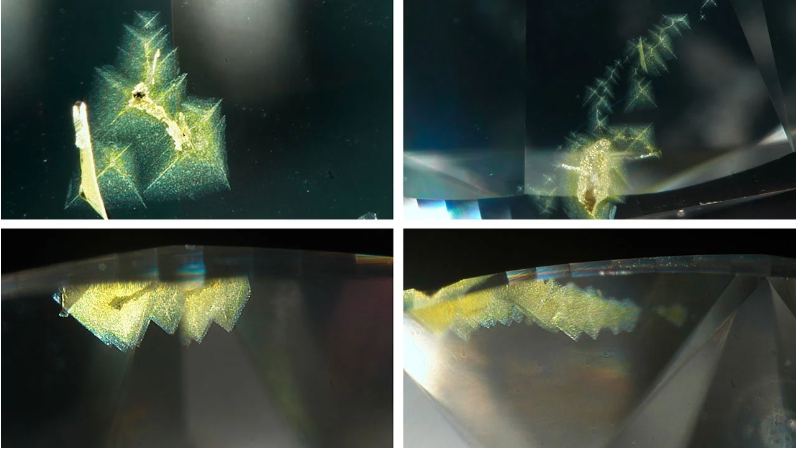
A yellow diamond that the Gemological Institute of America (GIA) recently received for grading contained star-patterned inclusions that had the lab struggling to identify their source.
When the GIA examined the round brilliant, 2.50-carat, faint-yellow-green diamond at its lab in Carlsbad, California, it discovered “several randomly distributed yellow zones consisting of stacks of clouds with four-sided star patterns near the girdle,” according to an article in the Winter issue of Gems & Gemology, the institute’s quarterly journal. It described the clouds as “clusters of micro-inclusions, with the center of each cloud containing more intensely colored particles in a cross pattern.”
The uniqueness of the cloud pattern — which appeared as a row of bright-yellow overlapping triangles when viewed from a different angle — led the GIA to investigate the phenomenon in depth.
The stone “exhibited blue fluorescence to long-wave UV radiation,” while the cloud patches showed weak yellow fluorescence under a deep-UV imaging microscope, the lab found. Further testing indicated hydrogen-related defects. However, while such defects might create brownish or greenish components in the diamond’s body color, the lab did not believe they were the cause of the bright-yellow color zones in the diamond. That kind of color is generally due to “cape defects, H3 defects, isolated nitrogen (C-center) or a 480-nanometer absorption band,” according to the institute.
The GIA then used photoluminescence spectroscopy — a method for detecting defects in a diamond — on the yellow color zones and surrounding areas, but it found no evidence of either absorption-band or H3-related reasons for the inclusions. It did detect a nitrogen-vacancy center “only within the bright-yellow color zones, indicating that the yellow color was likely due to the presence of C-centers in a confined region on the surface of the diamond.”
A 2020 report about a near-colorless diamond that had formed a yellow overgrowth layer in the late stage of its development led the GIA to believe at first that this case could be similar.
“However, the composition and formation of the clouds of micro-inclusions coincident with the yellow color zones in this diamond are currently unclear and require further investigation,” the GIA concluded.
Image: A closeup of the starburst inclusion. (Gemological Institute of America)